Monday, July 25, 2011

I apologize in advance...

Here is a link to yet another video! 
HOWEVER, this one is not as educational. 
It is just really, really cute... and awesome. 
Not to mention funny.
Enjoy a break and check it out. 

Another Vide-OH! (Math 1512, Post 6)

So, here is another video I found....
Its a youtube video about.... you guessed it! M A T H. In this video a description of a new way to solve multiplication problems is explained and demonstrated. I had never seen it done this way but I thought it looked really interesting and wanted to share.

The general idea is that if you were multiplying 24 x 31 you would first draw two lines diagnal and draw an additional four lines next to them going the same way. Then drawing lines in the opposite direction you would cross the lines you already drew with a grouping of three lines and than one more in the same direction. So now, you would have a bunch of lines crossing on your piece of paper. The group of 2 lines next to the group of 4 lines represent the first number, the other lines represent the second number. (Check out the video if you are confused)

From there you count the intersections in the beginning, middle, and end of your diagram then add them together to get your solution. Again, if this explaination is confusing for you watch the video, maybe even a few times to get the jist of what is going on here. She talks fast and if you are not familiar with solving this way, it can be kinda tough. Its hard to teach an old dawg, like myself, new tricks sometimes. Anyways, give it a try and check it out. There are a lot of different ways to solve simple problems. I will be the first to admit that....

A) New things can be scary

B) It is hard to break habit and tradition.

But give it a try and see what is easier and makes more sense. An open mind can make a world of difference.

"A, B, C, It's as easy as 1, 2, 3" (Math 1512, Post 5)

WATCH THE VIDEO ABOVE! That is seriously an order. Karen Cheng, above, approaches song writing in a wonderful, mathmatical way. This video breaks down music into mathmatics as she explains the relationship between good sounding songs, with notes that work together, and fractions.

Notes that work well together have ratios or fractions that are smaller and simpler. For example the note A, whose sound is the most pleasing, has a ratio 2:1; the note B has a ratio of 3:2, which sounds good but not as good as A; C on the other hand is a ratio of 45:32! The difference in sound is visible through these fractions. And as she says in the video, using these notes that have a simple ratios, are really the building blocks to any classical song.

Like I've stated before in this blog, FRACTIONS ARE EVERYWHERE! I just happen to come across this video and the relation to music I think is just so great. It would be fun to share with a math class or a even a music class. Sometimes as a student, when sitting learning different, content its hard to think of when you will ever use this stuff again. This video is a good reminder for all those "wanna-be" rockstars out there that math is definitely worth investing in.

Sunday, July 24, 2011

Another Rant... (Math 1510, Post 6)

Alright, here is another one of my "rants" to get across the importance of starting our students out right and preparing them for the future. Through my time in the classroom in a leadership position, observing a variety of different classes and going through school myself, I have determined that we have a serious issue on our hands. Some may disagree with me but I believe we have a problematic reliance on technology.

Through computers, the internet, smart boards, calculators, and even cell phones, the ability to find or solve anything for ourselves is slowly diminishing. Why figure out the prime factorization of a number when you can simply ask google the same question and get the answer in less than a second? Say I am stuck in the past, too wrapped up in tradition, but I think as educators, parents and mentors need to encourage students to take the extra steps to do the work themselves. Provide them with the tools (or lack of tools in some cases) and enable them to not be self-sufficient.

I do not by any means disregard the importance of technology in the classroom. But I believe there is a time and place, it can hinder or it can help. Taking and making the time for students to get involved in both the technological attributes of the classroom and time to self-construct content in the classroom is really the key. I believe it is a balancing act. The fine line is the one we need to try our best to stay one. What do you think?

Roll Call! Where my blogs at?! (Math 1510, Post 5 & Math 1512, Post 4)

This title was a lame attempt at being cool. I apologize for that. Anyways, maybe you got my hint that today I will be sharing with you all some blogs that I find helpful, entertaining, and worth-while to keep up on and read. These blogs are all educationally based with some great resources and characters behind them. [WARNING: Not all of the blogs listed below are "Math" based blogs. However, they still have content that is relatable and useful for any classroom setting or teacher.]  I have thoroughly enjoyed reading each and connecting with them. So lets begin with this sort of "roll call" shall we?

First, we have Class Blog Meister. This blog follows a class of six year olds, lead by Mrs. Cassidy (the teacher), in their learning. It is an open invitation to see their classroom and help these students learn through constructive ideas and comments.  I like this blog because it very personal and as the reader you truly get a good glimpse at what they are working on and learning in their classroom. Good blog. Check it out - that's an order.

Second, is Successful Teaching with a great resources and ideas for any teacher, teaching any subject. Not only does the blogger share personal experiences and resources they find helpful but they have an extensive list of blogs and sites that they visit. This is a very resource-filled site. Give it a look and see what sticks out to you personally, there is sure to be something for everyone.

Next, is a blog titled Regurgitated Alpha Bits. Starting with the title, this blog is out to appreciate the humor in the classroom. A veteran teacher describes her time in the classroom and reflects humorously at  it all. I think that this light hearted blog is a great one to follow for some laughs and some an inside look at one teachers reflections and feelings towards all that comes with the joys and trials of teaching.

Other ones that I would like you all to at the very least inquire about by clicking on the links are...
As I have said in some way or another at least four times in this post, CHECK THESE SITES OUT! Let me know what you think? I am always anxious to read comments and have you share with me! Got some good ones you like reading? Share the love, share the love. 

What are the chances? (Math 1512, Post 3)

What are the chances? Some thoughts on probability...

What is probability? Simply put, probability is the use of numbers to describe and determine the chance of an event or outcome happening. So simple right? Well, sometimes probability problems can get confusing or complicated because instead of solving a problem that is concrete, probability problems deal with events and situations that most of the time have not happened yet. For myself, and some of the students I have worked with, this less concrete way of thinking can "trip" you up. It all depends on your learning style - which itself is a topic for another day!

I am more of a concrete thinker. So having a plan of action when I work on problems like this is very helpful. I have just 4, count it 1.. 2.. 3..  4 simple steps to be more successful when working on probability problems.

  1. Clearly understand the event - This means asking questions like... What does the situation involve? What needs to be determined? What are the key points of data shared in this problem? Understanding exactly what you need to find will help save a lot of time and prevent you from determining the outcome of an event that you don't need to.
  2. Select a model for the event - Models can help you visually determine and develop a plan when approaching a new problem. Ask questions like... Should the answer be estimated or calculated? What method of calculation should I use? What strategies might be useful here?
  3. Conduct trials using the model - Implement the strategies you determined will be helpful, more simply choose one and test it! (This is where you will get an answer.)
  4. Look back - Ask the important questions that review your strategies, implications, and solutions you determined and worked out... Is the answer reasonable? Are the calculations correct? 
If you are a concrete thinker like myself or if you have students that learn this way, try it out. Let me know how it works for you. If there is one thing I've learned by growing up it is this - There is nothing as helpful as taking your time and being prepared. Think about it.

Would you like your pickle in halves or fourths? (Math 1510, Post 4)


Today, while waiting for my Jimmy John's sandwich and jumbo kosher dill pickle, the guy behind the counter asked me if I would like my pickle cut in halves or fourths. This was an easy decision for me because obviously a pickle that big would still be too big if it were cut in half, so fourths it was. This may seem like a random and irrelevant event to share with you, my fellow blog readers, however the more I thought about it the more applicable it became. Fractions are all around and we really use them pretty frequently. When we measure out ingredients, check the levels of fluid levels in our cars, read the clock hanging on the wall, or even order our favorite quarter pounder with cheese, we are using fractions.

But if fractions are all around, how come I am still not good at them?! You may be asking yourself the same question. (Maybe you're not and you're a super genius and don't have this question but just play along for a little bit.) My response to that question is that we may be better than we think we are when with dealing with fractions.  I really hadn't realized how much I use fractions in everyday life until I was asked about my pickle today. Fractions are everywhere! 


In math fractions are taken to a whole other level though, instead of more simply recognizing and interpreting fractions we are asked to add, subtract, multiple and divide fractions with all sorts of different characteristics like proper, improper and mixed types of fractions. Below is a list of "fraction rules" that I found on Bright Hub, a website that provides information and resources to help set its viewers in the right direction. I suggest checking out the link to get even more information of fractions. 


Fraction Rules (directly from brighthub.com):

  • If the numerator remains the same for all fractions but the denominator gets larger, the actual value of the fraction gets smaller. This fraction rule is because of the fact that if the denominator increases then the whole is divided into more parts. Imagine your favorite cookie. You have to share it with your sister. Would you want 1/2 of the cookie or would you want 1/10 of the cookie? You want 1/2 of course because it's going to be a bigger piece!
  • When adding or subtracting fractions, the denominator must be the same for both fractions in order to perform the operation. This rule makes sense because you cannot add fractions from different groups. For instance, you cannot add 1/2 and 1/4 because they represent different groups.
  • When adding or subtracting fractions, the denominator remains the same while the actual mathematical operation is performed on the numerator. You are working with parts of the whole. Therefore the whole doesn't change, only the parts do. So 2/4 added to 1/4 would equal 3/4. See how the numerator changed but the denominator didn't?
  • Since the denominators have to be the same in order to perform addition and subtraction, you sometimes have to change the fraction. The only way to add numbers like 1/4 and 1/2 is to make the denominators the same. To do so, you need to multiply 1/2 by 2/2. When you change fractions, you must do to the top what you do to the bottom. You aren't actually changing the value of the fraction, just the way it is written. 1/2 will become 2/4 when multiplied by 2/2.
  • When multiplying fractions, numerators multiply with numerators and denominators multiply with denominators. For example, 2/4 times 3/1 would mean 2 times 3 and 1 times 4. Your answer would be 6/4.
  • Fractions can be used as division problems. 2/4 means 2 divided by 4. The top number (numerator) is always divided by the bottom number (denominator)

Read more: http://www.brighthub.com/education/homework-tips/articles/33759.aspx#ixzz1T34orXjF


Hopefully this helps and go ahead and think about fractions more often! They are all around us.

Tuesday, July 5, 2011

That's a square. No, a circle. No, a trapezoid? (Math 1512, Post 2)


 "What's a rhombus?" 

Sounds like an easy question right? Wrong. Watch the video above and you will see how much trouble that question really was to answer. It seems almost ridiculous that we can go through years and years of school and still not be able to correctly answer simple questions about shapes. We "learn" information, practice and review with the hope that we can spit out the right answers when we are tested and move on to the next chapter.

I keep coming back to curriculum, the way we teach it and the lack of understanding on content that seems so basic. Maybe it is just me and this gap we have is just what I've seen through my experiences but this video does attest to that gap. So, to aid you, my fellow bloggers and blogger readers, in order that you do not lack basic shape knowledge below are a few links that review of this material in a more pleasant format. Enjoy!


Common Core - For or against? You decide. (Math 1510 - Post 3)

The Common Core State Standard may be something you haven't heard about before. Their mission as described on their website is to:

  • "Provide a consistent, clear understanding of what students are expected to learn"
           ---> SO THAT. . .

      • "Teachers and Parents know what they need to do to help them"
      •  The young people of today have the knowledge and skills they need for success in college 
      • Fully prepared American students will be in the position to compete successfully in the global economy, in-turn bettering our communities 

That sounds good to me! How about you? How many times have you gone to your parent or has your child come to you looking for help? It can be difficult to help or get help when your not sure what criteria or understanding needs to be met. Common Core State Standard Initiative is trying to bridge and connect parents, teachers, and students with the standards and concepts needed for success in college and  in the work force. This understanding amongst all parties is what helps make for successful learning.

Minnesota, North Dakota, Nebraska, Montana, Texas, Washington, Alaska and Virginia, all have not adopted this Common Core State Standard Initiative. So is there another side to this seemingly positive initiative? Probably. Check out this article from Heartland.org's School Reform News and let me know what you think. There are two sides to every story.

Friday, June 24, 2011

"Downloading Answer - Time Remaining 04:14" (Math 1510 - Post 2)


Mental math is not be a hard concept to understand. Do the math in your head. For me, somewhere between understanding that statement and doing the math in my head, my brain has a difficult time. Mental math does not come easily for everyone but in our text book, Mathematics for Elementary School Teachers, they share some basic techniques that make mental math a little easier to do.

The first one is counting on. When you count on you can count using either 1, 2, 3, etc. or 10, 20, 30, etc. This is very basic mental math that is vital for young students to understand and start practicing so that they can build on basic concepts like this one and do more complex mental math.  Handy when adding, counting on is used like this...
Example: 68 + 50
50 = 5 - 10s
So starting at 68, add five 10s.
68, 78, 88, 98, 108, 118.
68 + 50 = 118

The second one is breaking apart numbers. This is very useful in addition and subtraction. When adding (or subtracting) multiple digit numbers, students can separate the numbers into easier, smaller, or more reasonable parts and act on them then.
Example: 344 + 652
300 + 40 + 4
     + 600 + 50 + 2
900 + 90 + 6 = 996

Monday, June 20, 2011

Standard Devi - what ......? (Math 1512, Post 1)

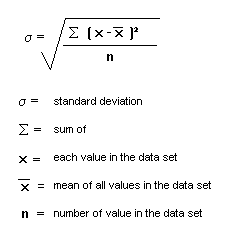
Wow, well the jump from week one to week two was a big one. Or at least it felt like it. The homework was going fine until I came to a question about Standard Deviation and saw a formula that looked a little something like this...


Now I haven't seen anything like that for a LONG time. After years of living a life evade of anything but simple mathematics, the Standard Deviation formula was a wake up call! Having been dependent on my calculator by the middle of high school my skills are lacking to say the least. But with this chance to go back and not only learn math and the concepts, but to learn effective ways to teach them I thought I should try and do my best to more deeply understand what I am doing when I do a math problem. I've created a list of things I am doing to help me better understand, see, and watch for mistakes as I work on a problem...

  1. Read the problem thoroughly - that means all of it. Understand exactly what the question is asking, and what solution you need to find. I have wasted so much time "reading" questions and missing just a little piece and coming up with the wrong answer. So read it!
  2. SHOW YOUR WORK. I have been told a hundred times, by my math teachers especially, to "show your work", "let me see every step", etc. And you know what? By showing your work and being able to see the steps you make you really can better understand what exactly you're doing and how it all works and fits together. Calculators are great... but they can really hinder a better grasp of mathematic concepts and formulas. 
  3. Finally, double check your answer. This may seem like a waste of time. The idea of it may have you wanting to pull your hair out BUT double checking your answers and the steps you took to get there, especially when you're feeling a little fried, is a foolproof way to make sure you do it right, and do it right the first time. 
Hopefully, that will help you as much as it helped me. Until next time... 


Math: The good, the bad, the do-able? (Math 1510, Post 1)

Hello my fellow bloggers. I am finding that blogging is a lot easier said then done. Between distractions and having too much to say I am afraid a lot may go unsaid... for now. But let's begin!

What an experience so far! After having not taken a math course in quite a few years, I will be the first to admit even the easy stuff is not so easy. In my early years in education math was just another subject. As I continued on however math became a dreaded, hard-to-understand, and down right un-relatable topic I had to cover in school. Now however, as I begin with the basics again I have a new, ever changing, outlook on math education.

There is no doubt that the push for math is one that has been years in the making. This 2006 article from the New York Times is evidence of that. In my opinion the understanding of the basic mathematics, as well as the understanding of how they work is key. Simple concepts like the ones I re-learned last week are a great example of this. Multiplication, division, and simple mathematical processes are ones I understand, so doing them is a lot easier.

Techniques and approaches are viewed differently across the board. My opinions are still formulating, that is for sure. I am interested to see how things change over this summer semester - through this blog. Regardless of all the different opinions I read and listened too this week, one thing I am sure of... I need to brush up on some math skills! I'm searching the internet far and wide to find fun, interesting, and helpful math activities/games/etc. If you have any you know of feel free to comment and leave a link!  This site I found is a great quizzing tool that's for a good cause - check it out!

Thursday, June 16, 2011

Technologically challenged is just the beginning.

It might just be me but the technical difficulties I faced while creating this blog we're almost humorous. I've never really been a blogger but bare with me as I share my thoughts, feelings, tips and resources I have discovered about math and its role in an Elementary Education. Thanks for reading, my fellow bloggers!