Friday, June 24, 2011

"Downloading Answer - Time Remaining 04:14" (Math 1510 - Post 2)


Mental math is not be a hard concept to understand. Do the math in your head. For me, somewhere between understanding that statement and doing the math in my head, my brain has a difficult time. Mental math does not come easily for everyone but in our text book, Mathematics for Elementary School Teachers, they share some basic techniques that make mental math a little easier to do.

The first one is counting on. When you count on you can count using either 1, 2, 3, etc. or 10, 20, 30, etc. This is very basic mental math that is vital for young students to understand and start practicing so that they can build on basic concepts like this one and do more complex mental math.  Handy when adding, counting on is used like this...
Example: 68 + 50
50 = 5 - 10s
So starting at 68, add five 10s.
68, 78, 88, 98, 108, 118.
68 + 50 = 118

The second one is breaking apart numbers. This is very useful in addition and subtraction. When adding (or subtracting) multiple digit numbers, students can separate the numbers into easier, smaller, or more reasonable parts and act on them then.
Example: 344 + 652
300 + 40 + 4
     + 600 + 50 + 2
900 + 90 + 6 = 996

Monday, June 20, 2011

Standard Devi - what ......? (Math 1512, Post 1)

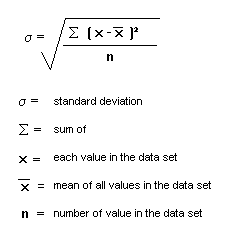
Wow, well the jump from week one to week two was a big one. Or at least it felt like it. The homework was going fine until I came to a question about Standard Deviation and saw a formula that looked a little something like this...


Now I haven't seen anything like that for a LONG time. After years of living a life evade of anything but simple mathematics, the Standard Deviation formula was a wake up call! Having been dependent on my calculator by the middle of high school my skills are lacking to say the least. But with this chance to go back and not only learn math and the concepts, but to learn effective ways to teach them I thought I should try and do my best to more deeply understand what I am doing when I do a math problem. I've created a list of things I am doing to help me better understand, see, and watch for mistakes as I work on a problem...

  1. Read the problem thoroughly - that means all of it. Understand exactly what the question is asking, and what solution you need to find. I have wasted so much time "reading" questions and missing just a little piece and coming up with the wrong answer. So read it!
  2. SHOW YOUR WORK. I have been told a hundred times, by my math teachers especially, to "show your work", "let me see every step", etc. And you know what? By showing your work and being able to see the steps you make you really can better understand what exactly you're doing and how it all works and fits together. Calculators are great... but they can really hinder a better grasp of mathematic concepts and formulas. 
  3. Finally, double check your answer. This may seem like a waste of time. The idea of it may have you wanting to pull your hair out BUT double checking your answers and the steps you took to get there, especially when you're feeling a little fried, is a foolproof way to make sure you do it right, and do it right the first time. 
Hopefully, that will help you as much as it helped me. Until next time... 


Math: The good, the bad, the do-able? (Math 1510, Post 1)

Hello my fellow bloggers. I am finding that blogging is a lot easier said then done. Between distractions and having too much to say I am afraid a lot may go unsaid... for now. But let's begin!

What an experience so far! After having not taken a math course in quite a few years, I will be the first to admit even the easy stuff is not so easy. In my early years in education math was just another subject. As I continued on however math became a dreaded, hard-to-understand, and down right un-relatable topic I had to cover in school. Now however, as I begin with the basics again I have a new, ever changing, outlook on math education.

There is no doubt that the push for math is one that has been years in the making. This 2006 article from the New York Times is evidence of that. In my opinion the understanding of the basic mathematics, as well as the understanding of how they work is key. Simple concepts like the ones I re-learned last week are a great example of this. Multiplication, division, and simple mathematical processes are ones I understand, so doing them is a lot easier.

Techniques and approaches are viewed differently across the board. My opinions are still formulating, that is for sure. I am interested to see how things change over this summer semester - through this blog. Regardless of all the different opinions I read and listened too this week, one thing I am sure of... I need to brush up on some math skills! I'm searching the internet far and wide to find fun, interesting, and helpful math activities/games/etc. If you have any you know of feel free to comment and leave a link!  This site I found is a great quizzing tool that's for a good cause - check it out!

Thursday, June 16, 2011

Technologically challenged is just the beginning.

It might just be me but the technical difficulties I faced while creating this blog we're almost humorous. I've never really been a blogger but bare with me as I share my thoughts, feelings, tips and resources I have discovered about math and its role in an Elementary Education. Thanks for reading, my fellow bloggers!